The Secret Raw is a collection of food documentaries that share stories from various Indigenous communities in Thailand. It explores their knowledge of managing food and natural resources, revealing the secrets hidden within their traditions.
Episode 1: Seeds of Hope: ‘Na Tae Ka’ – A Testament to the Restoration of Food Security for Lahu Women.
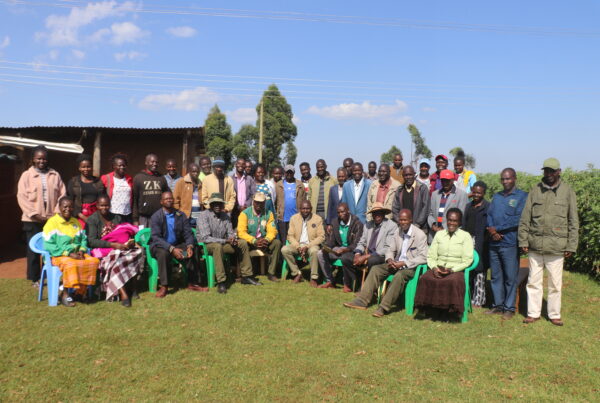
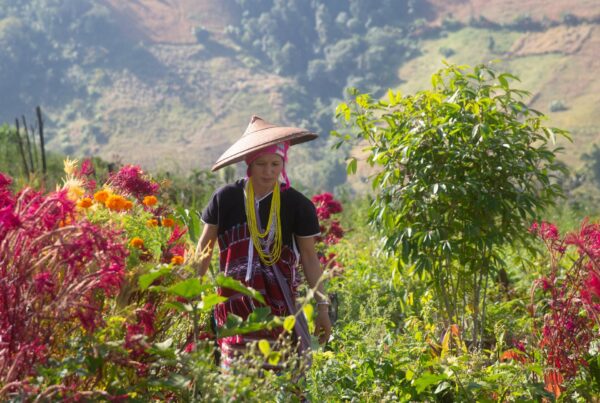
‘Na Tae Ka’ translates to “the headwaters of the Mae Taeng River.” It’s a small village in Ban Kae Noi, Chiang Dao District, Chiang Mai Province, a Lahu community of over 70 households, and the only community located at the headwaters of the river. Nanu-Kulsuwarak Puiyi, the women’s group president, explains that the Lahu people’s way of life is intertwined with agriculture and nature. They maintain traditional beliefs and revere the deity U-Sa, the supreme god. Throughout the year, they hold 5-6 major rituals related to agriculture.
However, when faced with the COVID-19 crisis and natural disasters, and the necessity to return to their communities, even with money, they couldn’t buy the plants they once ate or regain their traditional way of life. Food from outside was also difficult or impossible to obtain. This reinforced the realization that the women’s group and the community needed to reconsider their situation. Sister Nanu and the women’s group then collaborated. They began raising funds and planning to revive local seeds of plants that the community already consumed – a primary consideration as the Lahu tribe prioritizes self-sufficiency and rituals. They started by surveying what was missing or nearly extinct, searching for and exchanging seeds with other communities, and planting them in ‘community plots’ without chemicals. Through trial and error, they eventually managed to revive over 300 species of food and ritual plants.
“COVID-19 has reinforced the need for plants that can be stored for a long time and are safe to eat. We already use our own plants for our ceremonies, so buying them wouldn’t be reassuring. Restoring our traditional ways of life, in line with our way of life, is one solution or option for the survival of the Lahu people. If a disaster lasts for years, we can survive.”
The seed restoration efforts of the Na Tae Ka women’s group go beyond reviving lost plant varieties such as early-maturing rice or perilla seeds. It also aims to preserve ancestral flavours and ensure food security and survival, helping them overcome crises such as pandemics, natural disasters, or global fluctuations.
For the Lahu people, seeds represent hope and the power of life, reflecting the teaching to always carry seeds to sow when a suitable area is found. The struggle of the Na Tae women’s group is therefore a stand to preserve food security, identity, and dignity, ensuring their roots thrive and flourish in this forest.
Episode 2: A Legacy of Food Preservation: ‘Fermented Soybeans’ from Ban Tor Pae
Ban To Pae, Mae Ngao Subdistrict, Khun Yuam District, Mae Hong Son Province, is a community of over 300 Tai Yai households. The story of fermented soybeans’ journey to the city comes from Liu – Wanitchaya Kantayawong, who considers herself a “mother” and has grown up surrounded by fermented soybeans. Since birth, she has seen fermented soybeans a staple in every kitchen, to the point that it can be said they are the soul of the Tai Yai culture.
“When I was a child, I wanted to help my mother make fermented soybeans. It was a memory that got both my hands and my heart dirty, and it has stayed with me ever since,” Liu said.
How are resources managed? What does this have to do with food security?
The fermented soybeans of Ban Tor Pae begin with self-cultivation, without the use of chemicals. When harvest time arrives, the soybeans are carefully selected, soaked in water for 1-2 hours, and then boiled for another 2-3 hours until tender. The soybeans are then placed in baskets lined with banana leaves (either teak or other hardwoods), which retain heat well, and left to ferment until white mould grows. This results in fermented soybean sheets. In the past, women in the village, when not busy with farm work, would gather to make fermented soybeans, fostering community participation and ensuring food security, as no other food could be preserved as long as these sheets.
In the past, seasonings and flavourings weren’t as diverse as they are today. Making fermented soybeans, besides providing beneficial protein, also adds a unique flavour. It can be eaten plain or used in cooking to create a distinctive taste. The flavor, aroma, and story of fermented soybeans here can only be found in Ban To Pae, where they are a core ingredient in Shan cuisine.
“Fermented soybeans are a staple ingredient in every meal. The Tai Yai people have a spiritual connection to eating and talking about fermented soybeans,” brother Liu said with pride.
So how is this important to city dwellers?
Finding authentic products without added additives, or knowing the origin of what you consume directly from the producer, isn’t as easy as simply walking into a convenience store. Therefore, attending the Get Rotate event isn’t just about enjoying the product; it’s about preserving the traditional wisdom of making fermented soybeans for the community, and also ensuring the safety of what you’re consuming.
Sister Liu, along with the Ban Pae community, continues to innovate and expand the variety of dishes made from fermented soybeans, connecting this culinary heritage to everyone of all ages and ensuring that this spiritual protein of the Tai Yai people does not fade away with time.
Episode 3: Rotational Gold – Embracing the art of beekeeping
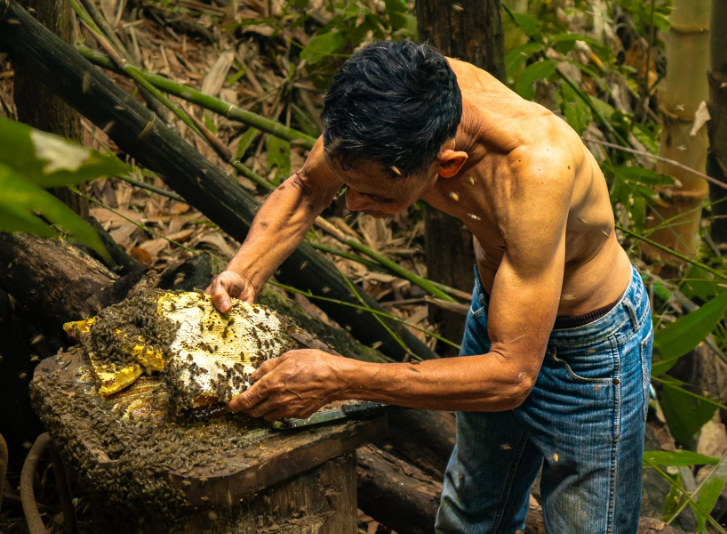
Nestled within a hidden valley in Chiang Rai, the Karen people of Ban Hin Lad Nai village are weaving a new chapter of their future — by embracing the art of beekeeping as a bridge connecting the spirit of their ancestors with today’s rapidly changing world. This is a journey of community resilience and profound adaptation, a testament that people and forests can truly coexist — told through the story of community elder “Chai Prasert,” who rose up to empower his community through honey, after more than 15 years of trial and error, ultimately achieving success that endures to this day.