Between 11 and 15 February 2026, members from 12 of the 13 partner organisations of the Transformative Pathways project met in Ayacucho, Peru to share experiences, build solidarity and to work together to strengthen Indigenous Peoples’ work to conserve and sustainably use biodiversity. Hosted by the CHIRAPAQ – Centre for Indigenous Cultures in Peru, the meeting began with a Quechua spiritual ceremony, which grounded the event in the land and culture of the region and its peoples.
Exchanging experiences and activities
The meeting included a presentation from each of the project partners, who come from Peru, Thailand, Malaysia, Philippines, the UK, and Kenya, and how each of them are working to raise awareness of, and scale up, biodiversity conservation on their lands and territories.
Throughout the project, Indigenous partners have taken a variety of different approaches to this based on their specific context. Activities they presented ranged from working directly with communities to co-design conservation approaches based on Indigenous values, to engaging directly with national and international actors in the biodiversity conservation policy space.
The Autonomous Territorial Government of the Wampis Nation (GTANW) from Peru, presented their autonomous cultural zoning plan, which establishes clear rules on permitted uses and protected areas on their land. This aims to ensure sustainable use of resources, to care for sacred sites, and to protect their territory from illegal mining and logging.
These presentations were met with high engagement from other partners and led to fruitful discussions on how activities carried out by one partner could also be replicated in other contexts and countries.

Traditional Peruvian foods laid out during the meeting. Credit Claudia Faustino, UNEP-WCMC
Community visit
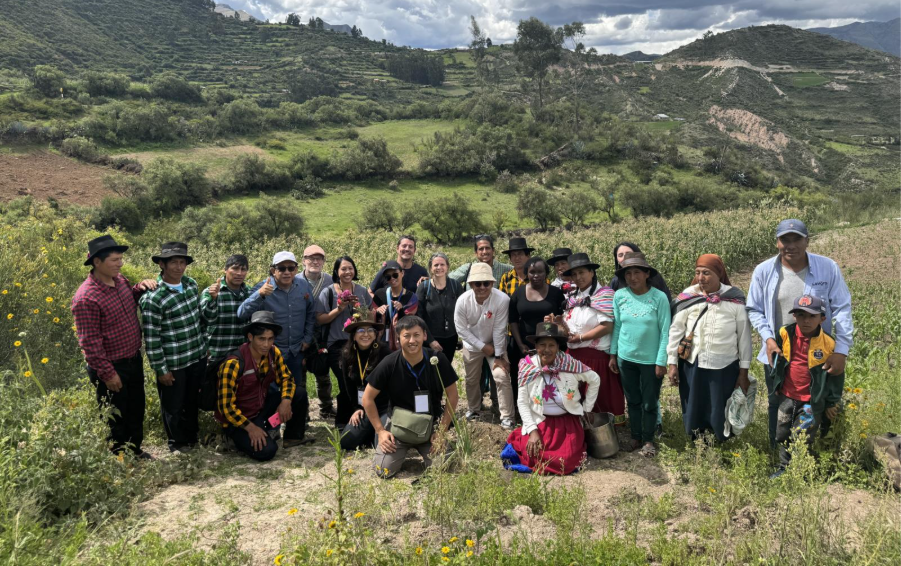
On the second day of the meeting, Transformative Pathways partners travelled to the Cayara, Tiquihua and Chincheros communities, where the community members discussed their strategies to protect their territories through activities such as reforestation and protecting water sources.
The communities also detailed their agroecological practices based on ancestral knowledge, for example how they farm according to the lunar cycle and how they have adapted their practices to build resilience to climate change. This highlighted to all the participants that the Andes region is not only a geographic region, but also a living territory, embodied in its people and its practices.
In the Cayara community, strong women’s leadership was evident, with women having a strong political voice and leading role in the community. Their vital role in food sovereignty was also made clear through the diversity of crops such as mahcha and roasted maize, as well as seed conservation and diversification.
The community also discussed the periods of political violence they have experienced, such as the Cayara massacre (1989) and the violence in Hualla (1986), highlighting that the justice process remains unfinished and that many wounds remained open. CHIRAPAQ has supported these communities to focus on the recovery of Indigenous food systems and native seeds to strengthen food autonomy and as a means of community reconstruction.

Transformative Pathways partners with the community. Credit: Wipawan Khoonthaweelapphol
Dialogue: Indigenous Peoples in defence of our sacred knowledge
On the third day of the meeting, a dialogue was held on ‘Indigenous Peoples in defence of our ancestral knowledge,’ which highlighted the importance of protecting traditional Indigenous knowledge. This remains an ongoing issue, as despite many national and international frameworks that aim to both include and strengthen the role of traditional knowledge, the implementation of these remain weak and often symbolic. Various countries reflected on the tensions between Indigenous knowledge and academia and the state.
During the dialogue, Dr. Torres Guevara, from the National Agrarian University of La Molina, highlighted that academia still struggles to integrate and fully recognise Indigenous knowledge. He emphasised that Indigenous knowledge evolves and adapts and is the reason behind the extraordinary agrobiodiversity found in Peru, and that it was essential to enable dialogue and sharing between scientific and Indigenous knowledge systems.

Transformative Pathways partners exploring the Tiquihua territory. Credit Kate Newman/FPP
Revitalising traditional knowledge and working to include it in national and international policy is a key focus of many partners in the Transformative Pathways project.
From Thailand, both the Inter Mountain Peoples Education and Culture in Thailand Association (IMPECT) and the Pgakenyaw Association for Sustainable Development (PASD) emphasised that traditional knowledge is protected by putting it into practice, which they do through creating differentiated management areas to strengthen community roles and restoration processes.
Parters for Indigenous Knowledge Philippines (PIKP) highlighted their comprehensive approach aimed at revitalising, documenting and strengthening indigenous knowledge, in both urban (Baguio City) and rural (Besao, Mountain Province) contexts. Their work combines conservation, indigenous food systems, healing practices, governance and organisational strengthening.
The annual meeting was a valued space to reconnect with Indigenous and allied organisations from across the globe, to share experiences, and to build solidarity between all partners. Over the next year, more collaborative processes will be set up, including virtual thematic exchanges on cross-cutting issues, and workshops on communication strategies and tools. The next annual meeting will be hosted by PACOS Trust in Malaysia.