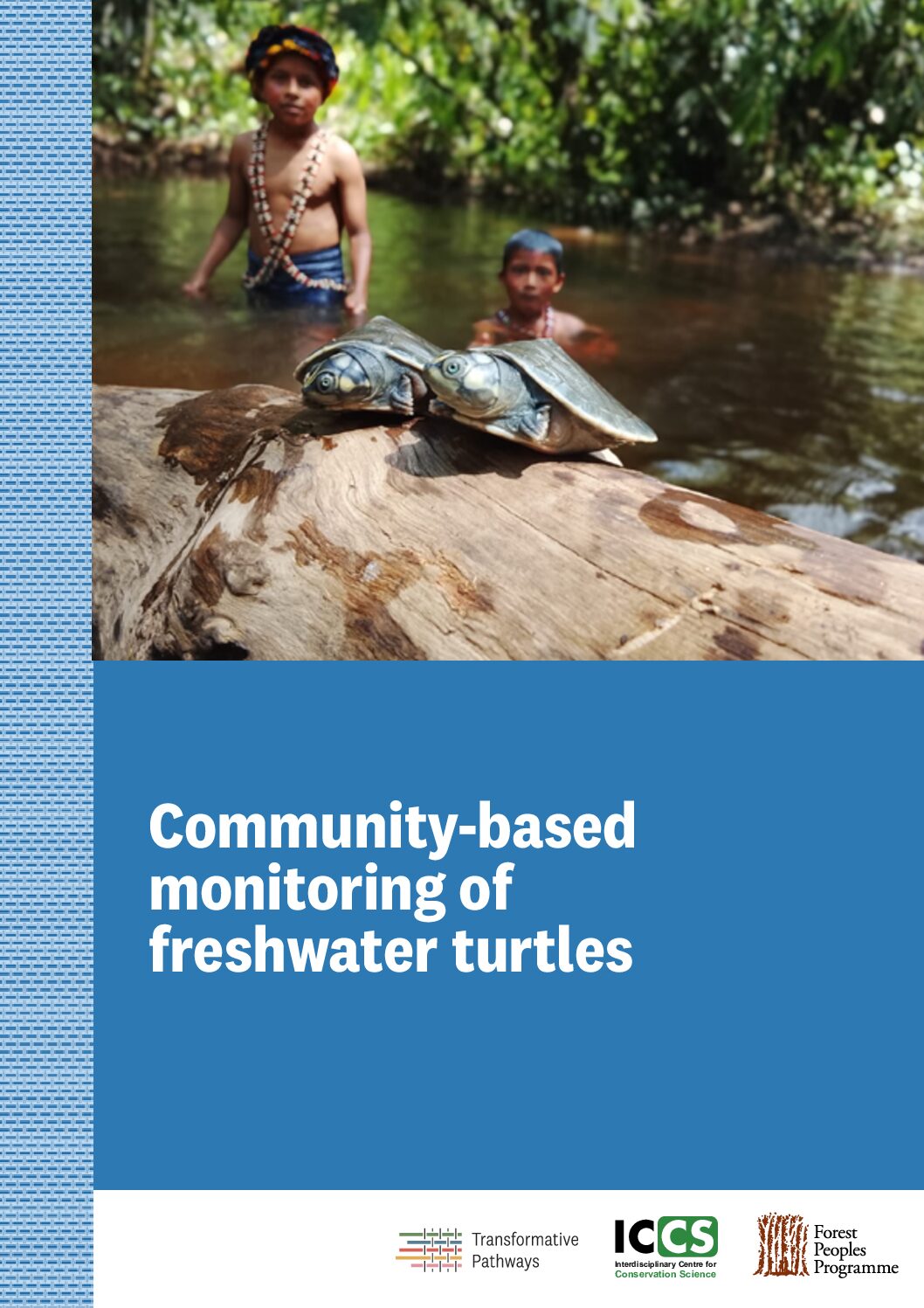
“Community-based monitoring of freshwater turtles” outlines six stages in setting up and carrying out community-based monitoring of freshwater turtles.
To successfully apply this turtle monitoring guide, the monitoring team is encouraged to receive ongoing training, including proper completion of forms, operation of GPS devices and semi-professional or professional cameras, and recording data in datasheets. Ongoing capacity building, along with technical assistance and support, should be provided until the monitoring team can confidently and independently carry out these tasks.
Monitoring turtles in your rivers and streams can help you track changes in turtle populations and their presence in the environment. It can involve collecting information on whether there are more turtles than there used to be, or less, whether there are any changes in how many nests there are each year, and whether there are plenty of young turtles to form the next generation of adults. If not, turtles may need help and protection to make sure they will still be there for many generations to come.
Community members may already have answers to some of these questions, based on their own observations and knowledge. For example, you may know several places where turtles nest each year, or where they are often seen basking in the sun. Coming together once a year to discuss whether there are still plenty of turtles, whether they are increasing or decreasing, whether they have changed the areas that they use, and why any changes might have happened is a good first step in assessing whether turtle populations are in good condition and if action might be needed to make sure they stay that way. But unless you record these observations systematically, you may not notice changes until they are severe. And unless community members go regularly to different parts of the overall territory, you won’t have a full picture of turtle populations across the whole area. For example, people’s observations might be restricted to the local area, or to transport routes along the lower sections of major rivers.
More information about how to systematically record observations about the state of the environment can be found in the guide Introduction to Community-Based Environmental Monitoring: A Practical Guidance for Monitoring of Natural Resources by Indigenous Peoples and Local Communities.
This guide is supplementary to Transformative Pathway’s “Community-based monitoring of river health and biodiversity,” with the below Section 5 dedicated to monitoring freshwater turtles.
Dashed line